Shaping control
Current coarse observations and 1.7-yard lateral / 1.8-yard depth target offsets. Potential shaping rewards positioning progress alongside the existing win/loss outcome.
New study: guard recovery behind the QB, trained fresh →
BEHAVIOR LAB / 04 — GUARD REFINEMENT
Three variants. Five fresh seeds each.
Better observations and finer movement, tested separately.
01 / BEST CHECKPOINTS, UNSEEN TESTS
Loading completed experiment…
| Variant | G wins ↑ | Seed range | Lane coverage ↑ | Wrong-way motion ↓ |
|---|
Means and standard deviations are across five independent training seeds. The same held-out scenarios are shared across variants and seeds. Checkpoints are chosen by validation wins only; these test results never choose the checkpoint. Lane coverage means G is between DT and QB and within 0.8 yd of their connecting line. Wrong-way motion measures free-movement time traveling laterally away from that line while misaligned. These are geometry proxies, not NFL technique scores.
| G wins · best checkpoint | A · Control | B · Observations | C · Finer control |
|---|
02 / MATCHED SCENARIOS
Each card faces the same DT plan, starting positions, QB depth and initial random seed. Learned openings and movement can differ. Choose the same training seed to compare the variants fairly. Replay never trains the players.
GUARDDTQBDashed line: direct rush laneTrails: player movement
Loading saved policies…
Download links include the variant and engine identity. Use these bundles with this study viewer; the main lab’s save format has different observation semantics.
03 / CHECKPOINT SELECTION
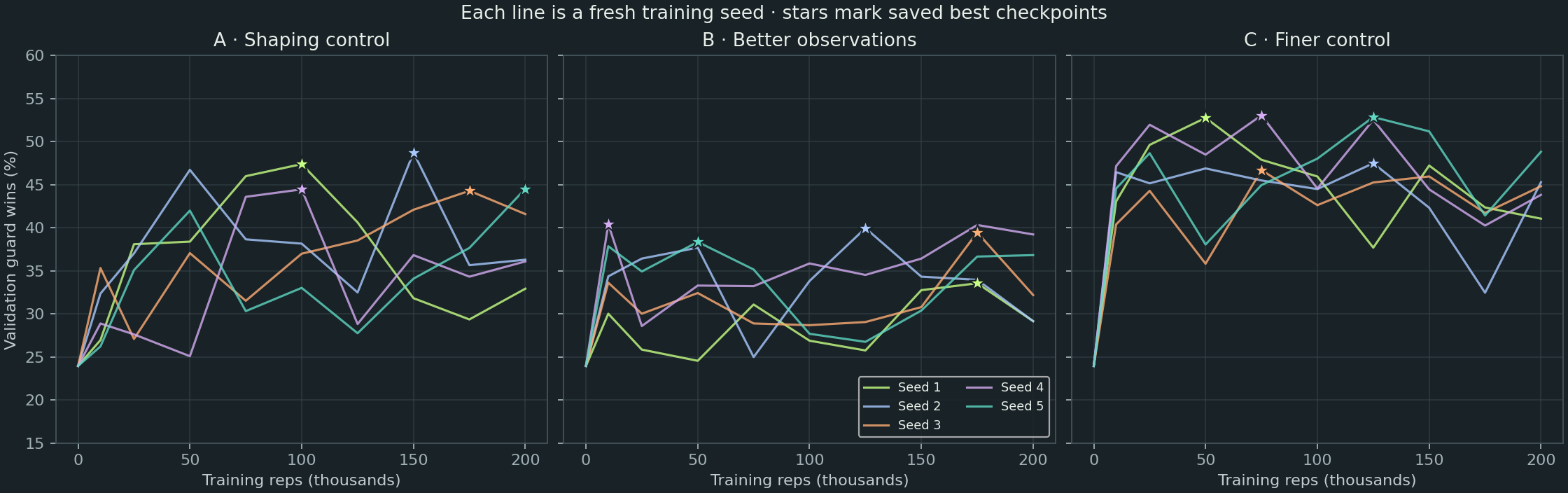
Ten snapshots per run, including zero training. At each snapshot, 3,000 fixed validation scenarios measure guard wins. The highest score wins; ties keep the earlier checkpoint. All 15 runs still complete exactly 200,000 training reps.
| Variant / training seed | Best at | Validation wins | Held-out best wins | Held-out final wins |
|---|
04 / LEFT–RIGHT AUDIT
The old 10M shaping policy wins 50.5% on the left and 22.2% on the right in physically mirrored setups. Reflecting its entire learned policy—including directional state bins and actions—produces matching trajectories in all 3,000 audited pairs.
Scripted steering revealed two rare divergences in 3,000 pairs: perfectly centered escapes always chose right. The new study resolves exact directional ties with a seeded left/right choice. After that shared correction, all 6,000 mirrored pairs match within 0.0000001 yard and have identical outcomes and times. Mirroring also flips the hidden tie choice.
This supports learned preferences as the main explanation for the observed gap. It does not prove symmetry for every possible state. All new variants share the tie correction; the earlier lab and studies retain their original engines.
| New best checkpoints | Left wins | Head-on wins | Right wins | Mean absolute L/R gap |
|---|
The absolute gap is calculated separately for each seed before averaging, so opposite preferences cannot cancel each other out.
05 / WHAT CHANGED
Current coarse observations and 1.7-yard lateral / 1.8-yard depth target offsets. Potential shaping rewards positioning progress alongside the existing win/loss outcome.
Adds four three-category signals: signed protection-lane error, guard lateral velocity, DT-relative lateral velocity, and closing speed. Movement choices and rewards match A.
Uses 0.6-yard target offsets in all four directions. Observations and rewards match A. Targets guide normal acceleration and movement; players are never teleported.
Each seed starts at zero reps with empty movement tables and zero-valued opening tactics. Training scenarios are matched across variants within a seed and disjoint across the five seeds. Only the G trains. The reference DT playbook and million-rep test opponent remain frozen.
G: 315 lb, strength 89, speed 72, technique 70. DT: 280 lb, strength 74, speed 87, technique 70. All variants keep the same rewards, learning rates, exploration floors and 0.3s decision cadence. Potential shaping is 0.25 × [0.94 Φ(next) − Φ(current)], with terminal Φ = 0.
Best and final policies are evaluated on 6,000 scenarios each for the normal rush mix, recovery starts, a frozen million-rep DT, and authored steering. Authored steering disables only the guard’s learned movement while preserving its opening tactic. Test sets are disjoint from training and checkpoint validation.
The richer state table may need a different training budget. These five-seed results establish performance under this 200K-rep protocol, not a universal ranking of learning methods. Contact footwork remains authored.